SURUDEV Impact & 2026 Outlook
SURUDEV Impact & 2026 Outlook
Written on 2026-01-05 18:15:10Overview
In 2025, Sustainable Run for Development (SURUDEV) delivered measurable environmental, social, and economic impact through community-driven, nature-based solutions. Our work strengthened ecosystem restoration, improved rural livelihoods, expanded conservation education, and advanced applied research, while laying a strong foundation for scaled impact in 2026.
Environmental Restoration and Biodiversity Impact
Landscape Restoration: SURUDEV made significant progress in restoring degraded ecosystems across the Njising–Tabenken Forest Landscape. Over 300,000 native, environmentally friendly tree species were planted, contributing to the restoration of more than 200 hectares of degraded forest habitats and eight severely degraded water catchments. These interventions enhanced ecosystem integrity, improved water availability, and reduced pressure on remaining forest resources. Landscape restoration efforts were extended to Saah Village, where two heavily degraded water catchments were rehabilitated through the planting of over 8,000 native medicinal tree species, restoring approximately 5 hectares of land and strengthening long-term ecosystem services.
Sustainable Livelihoods and Eco-Village Impact
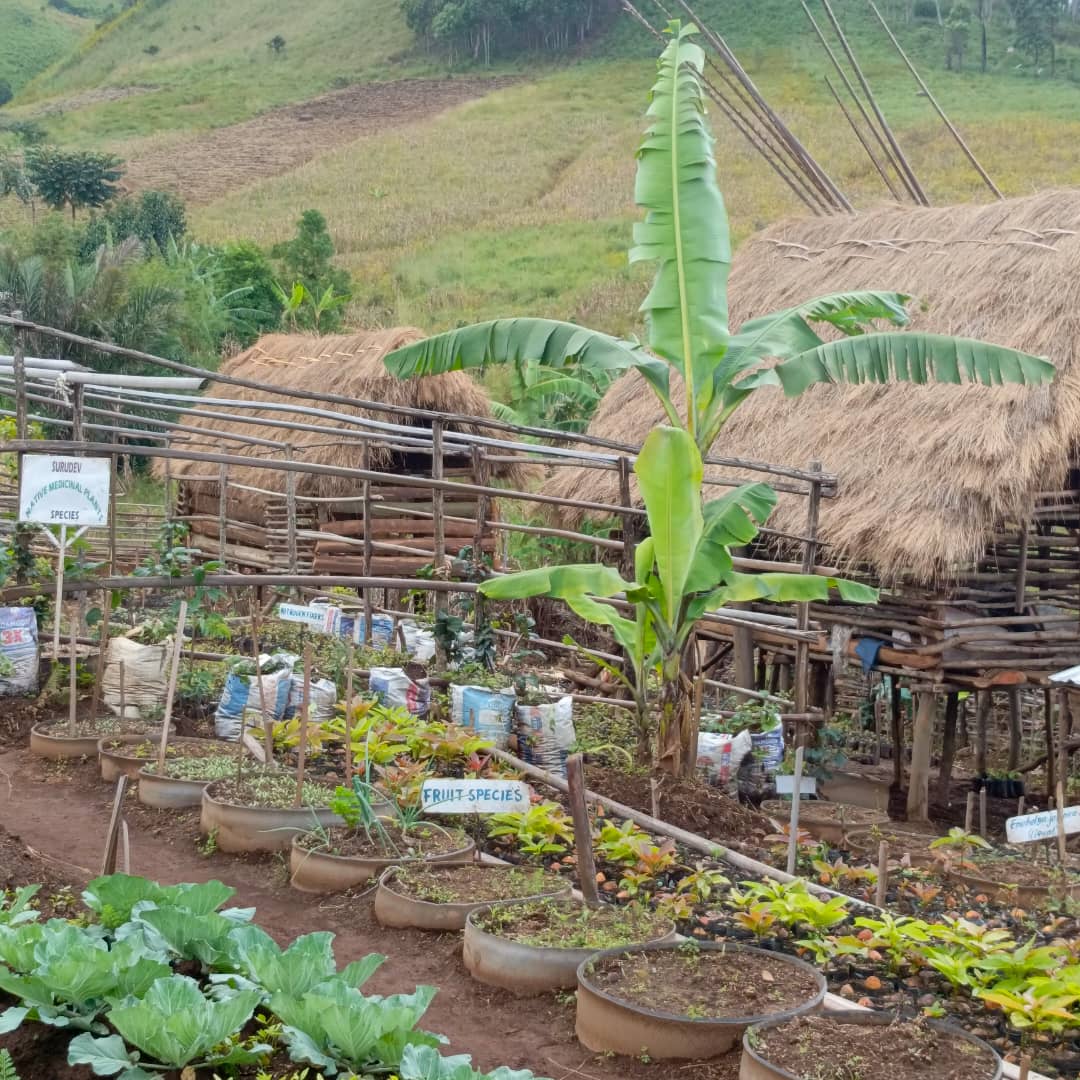
Eco-Villages as Demonstration and Training Hubs: SURUDEV’s eco-village model continued to serve as a practical platform for conservation-linked livelihoods. The Tabenken Eco-village remained fully operational, supporting organic fertilizer production, agroforestry, market gardening, mushroom cultivation, nurseries, and aquaculture.
In 2025, SURUDEV successfully established the Binka Eco-village on 1.5 hectares, integrating aquaculture, mushroom cultivation, small ruminant farming, apiculture, agroforestry, and market gardening. The site hosts two fish ponds, mushroom production units, goat and pig houses, a 100,000-capacity tree nursery, an apiary, composting facilities, propagators, and organic liquid fertilizer systems. Together, both eco-villages function as living laboratories for sustainable land use and green enterprise development.
Community Reach and Capacity Building: Through eco-village activities, trainings, and participatory programs, SURUDEV directly impacted over 2,500 women and men through skills development, knowledge exchange, and hands-on learning. Overall, more than 3,800 people benefited from SURUDEV’s interventions via employment, vocational training, and livelihood support.The eco-villages are now equipped to deliver structured trainings in mushroom cultivation, apiculture, agroforestry, pisciculture, goat farming, piggery, organic liquid manure production, and market gardening-supporting income diversification and reducing reliance on unsustainable forest use.
Conservation Education and Awareness: SURUDEV scaled up conservation education across Binka and the wider Njising–Tabenken landscape, reaching over 15,000 children through school- and community-based initiatives. Activities included poster displays, art, spoken drama, bird watching, tree planting, nursery establishment, and agro-ecological demonstrations. These efforts fostered environmental stewardship among young people while strengthening community engagement in conservation. Local and traditional ecological knowledge was identified and promoted, reinforcing culturally appropriate conservation practices and positive behavioral change.
Research, Innovation, and Species Conservation: In 2025, SURUDEV conducted targeted biodiversity research to inform conservation action. Pangolin monitoring resulted in a rare confirmed discovery, with 12 months of landscape monitoring identifying the presence of a single species. To strengthen compliance and awareness, 16 hunters were trained on wildlife laws and sustainable hunting practices. Migratory bird research in the Nkambe Plateau documented the ecological aspects of Palearctic Bee-eater species alongside several intra-African and European migrants, including six Bee-eater species, contributing valuable data to national and regional conservation knowledge.
Clean Cooking and Climate Innovation: SURUDEV developed a prototype improved fuelwood cookstove designed for rural communities. The innovation demonstrates strong potential to reduce fuelwood consumption, indoor air pollution, and deforestation pressures. Additional support is required to refine the design and scale distribution to beneficiary households.
StrategiC OUTLOK for 2026
Renewable Energy and Rural Innovation: In 2026, SURUDEV will launch a dedicated Renewable Energy Program to expand access to clean, affordable, and reliable energy in rural Cameroon, aligned with Africa’s renewable energy transition. The program will integrate Artificial Intelligence (AI), digital innovation, and productive use of energy (PUE) to increase rural incomes, create green jobs, and strengthen climate resilience. Planned activities include deployment of solar home systems, mini-grids, biogas units, and clean cooking technologies; AI-based tools for energy forecasting, smart metering, climate risk analysis, and precision agriculture; renewable-powered agro-processing; youth and women training; solar-powered community innovation labs; and development of bankable, AI-integrated renewable energy projects.
Scaling Conservation Impact: In 2026, SURUDEV will expand conservation action through:
- Elephant Conservation in Mount Cameroon, combining alternative livelihoods, agroforestry, and technology-driven monitoring to reduce human–elephant conflict.
- Coastal Marine Conservation along Cameroon’s west coast, focusing on biodiversity protection, research, beach clean-ups, and sustainable livelihoods.
- Mount Mbam Conservation Initiative, integrating conservation education, biodiversity research, restoration, and agroforestry.
- Plastic Waste Transformation, aiming to process up to 50,000 tons of plastic waste annually while creating up to 1,000 green jobs.
- Mandara Conservation Initiative in the Adamawa Region, combining biodiversity conservation, agroforestry, apiculture, and social enterprise development.
Back